iPhone 15 Pro
 Last modified December 19, 2024
When smartphones first appeared, I was a Linux teenage user. I was naturally drawn to Android “because it’s based on Linux.”
Later, I realized that the technical stack shouldn’t be the primary concern when buying a consumer device, so I tried an iPhone.
My family and stepfamily have been using Apple devices for years, and we’re all locked in our walled garden. I joined the club by buying an iPhone 6, upgrading to an iPhone XR, an iPhone 11 Pro, and finally, an iPhone 15 Pro.
I generally find iPhones the least bad compromise on the smartphone market. I am disappointed with this device, but the competition is even worse.
Why I got it
Staying in touch
My smartphone is very important to me socially. I use it to stay in touch with my family and stepfamily through two main channels: iMessage and shared photo albums on iCloud.
All our conversations have been on iMessage for a long while. We have several group chats depending on who needs to participate in the conversation. Asking everyone around me to move to another messenger would be a significant ask. It would generate friction and likely leave me out of the loop on several topics.
We also rely on an iCloud shared calendar to know when each other is available. It just works™, and we don’t need much more.
Taking & sharing pictures
We are also used to sharing photo albums on iCloud. We share pictures of the family, the holidays, our DIY projects in the house, etc. It is an essential aspect of our social interactions. There is no equivalent service that I would trust more than Apple’s iCloud, and that would allow me to onboard my family seamlessly.
It also means I need to get a good camera. I want to snap pictures of moments as they happen rapidly and keep them good quality. I really liked the pictures my iPhone 11 Pro took, and I thought the iPhone 15 Pro would be a significant update.
Organization & basic digital tasks
I write extremely slowly by hand. I take most of my notes on a computer, with a full keyboard to type rapidly, or on my phone, where I can type decently fast. I rely on Obsidian for my day-to-day organization, and for my organization as a freelancer. Having a phone that lets me use Obsidian is very important to me.
I also want to be able to look for things on the go, browse pretty much any website, and search my emails.
Banking
Because of the Payment Services Directive, most banks in my country “require” their customers to have a smartphone to which the bank can send a push notification to approve online payments. Some banks offer alternatives, but they are clunky.
USB-C
I upgraded to the iPhone 15 Pro because it was the first to finally have a USB-C port, and I wanted a single charger for all my devices.
What I like
I like having a familiar device I know how to use and being able to carry out most of my simple digital tasks. I like having Obsidian, an E2EE note-taking app, always in my pocket and synchronized with my computer.
I like having nice group conversations with my family with a decent level of confidence that not too much is leaking and that no creepy third party will get access to it to build profiles about us. I also like having a shared calendar with my family that just works and having shared photo albums with my family that just work, that are not used to train AIs or are not leaking anywhere.
Apple is known for having decent security practices. I could even enable Advanced Data Protection to limit what Apple can see by default. I have no illusions about the fact that Apple controls my phone, and if they wanted to get access to my data, they could. But I am happy they allow me to make it more difficult for them.
A pleasant surprise was that the iPhone can automatically pair with my MacBook Pro as a fancy webcam. As much as I hate its camera when snapping pictures, it does a good job of producing decent video in low light.
Another good surprise is having relatively fine-grained control over notifications and app permissions. It helps me make conscious choices when I want to browse messages or do a specific activity instead of being pushed to it by my phone.
Similarly to my MacBook Pro M1, this iPhone is a drama-free device that doesn’t get too much in the way. However, it’s not exempt from defaults.
What I don’t like
It costs an arm
The first thing I don’t like about the iPhone 15 Pro is its price. iPhones have always been pricey, but at €1120, it has become completely unreasonable.
Always-on
This phone also has an always-on display, which is very disturbing. I tried making it display a dark background when the phone is locked instead of my wallpaper, but it still made me feel like I constantly had new notifications. I ended up disabling the always-on display.
I’m trying to limit my phone usage to fully focus on what’s happening around me, present for people in my life, and get in the flow™ at work. Having a phone that constantly drags my attention to it is not great.
The camera is worse than my older iPhone
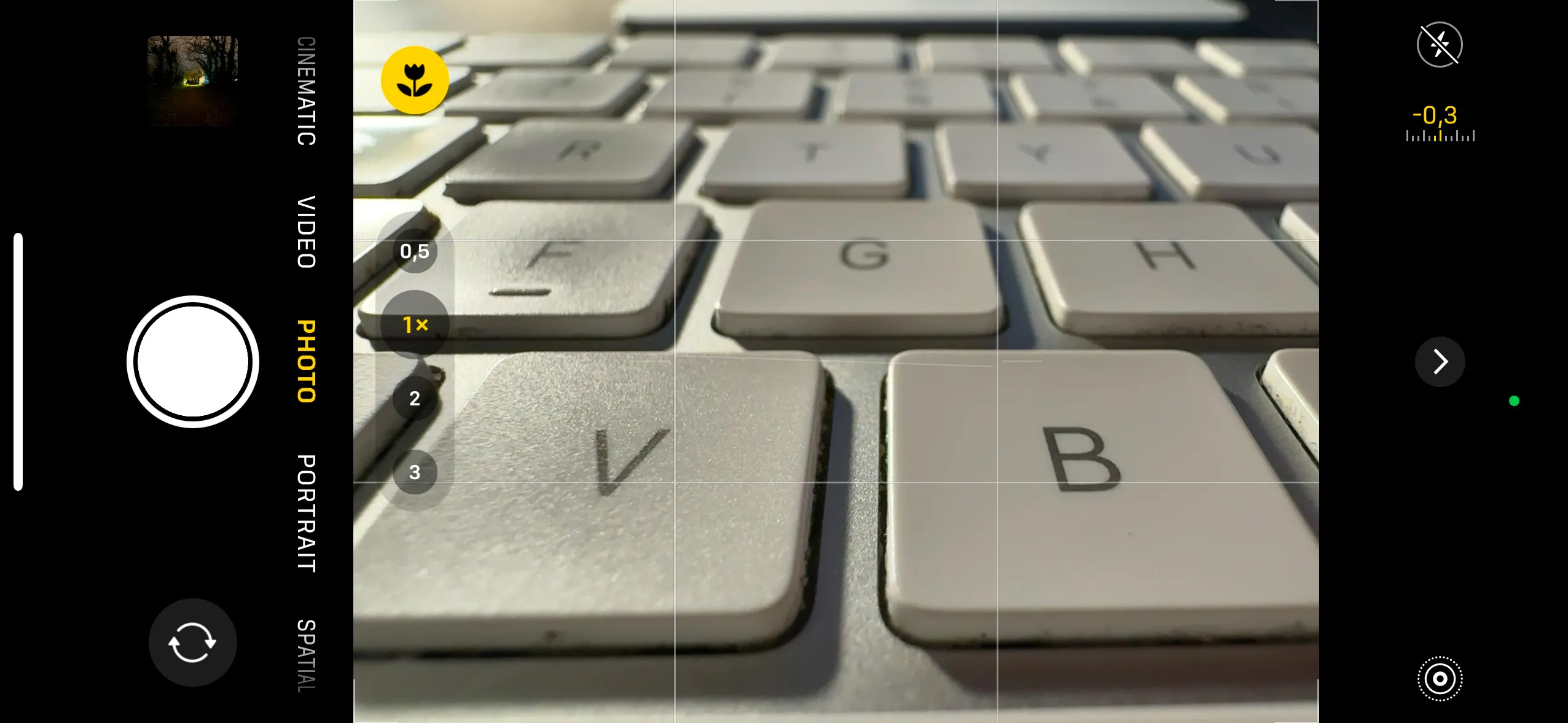
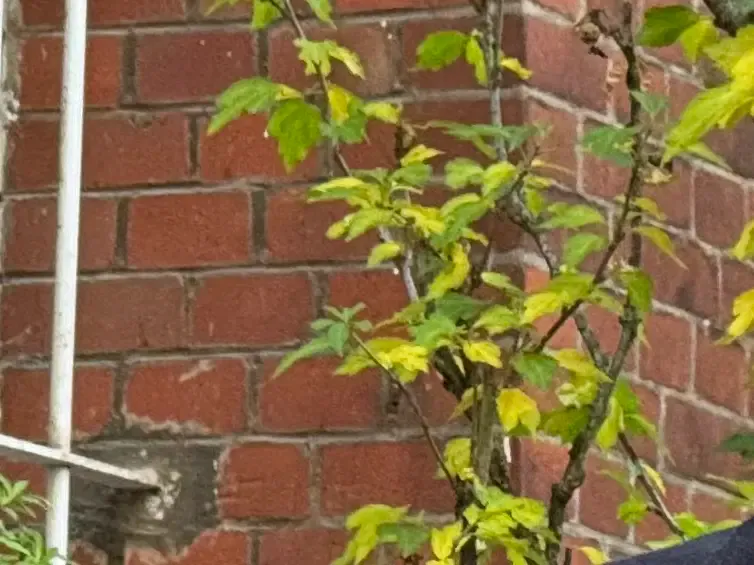
The photos are BAD. They could be somewhat okay, but not for this price. Apple’s built-in processing makes the pictures look oily, the skin tones off, and generally worse than on pictures taken with my iPhone 11 Pro. I can’t turn it off and keep Live Photos. That’s the biggest disappointment with this phone.
This iPhone also has an action button, replacing the old rocker switch that turned the phone into silent mode with a customizable button. The action button is a good idea in theory. I mapped it to “open camera,” but it fails to open regularly. The camera app stays dark, and the moment I wanted to snap is now gone, defeating the whole purpose of the button.
Battery life
iPhones are not necessarily the worst offenders on that front, but how come we still can’t have phones that can last a week on a single charge in 2024? It’s especially frustrating, given how much Apple’s laptops are ahead of the competition regarding battery life.
The UX is getting worse
This is probably the most controversial take of this review, and it might simply be me getting older. I used to look forward to the OS upgrade. I remember being in awe when iOS 7’s flat design replaced iOS6’s skeuomorphic design.
The interface architecture and spatial model made sense to me, and I found iOS intuitive. iOS18 is very different. The redesign of the Photos app made it much clunkier to use, and the spatial model no longer makes sense. Apple Mail tries to be smart and automatically sort my emails into arbitrary categories, but it fails miserably.
Conclusion
The iPhone 15 Pro is everything you can expect from modern-day Apple. It largely lives on the hype of previous iterations. Apple fails to innovate when it doesn’t severely regress, for example, with its camera.
However, Apple and its iPhone build on a very solid feature base and a walled garden, making it difficult to move elsewhere. The social pressure to use Apple devices and services is significant.
iCloud has a very strong value proposition and strikes an unmatched balance between convenience and security.
I’m not happy about this device because it feels way too overpriced for little innovation, but the services around it make it one of the least worst smartphone choices for me. If I had to do it again, I would keep my iPhone 11 Pro and only replace it when Apple drops support for it.





 Comments