A cheap VPS is a good front
 Last modified May 22, 2026
I have a server at home. It runs a Kubernetes cluster and a few services. I want to expose them to the Internet, so I can e.g. share public links from my Nextcloud, or synchronize my Kobo reader with Grimmory. But I don’t want to expose my home IP to the world, and I want to have some reasonable protection against unsophisticated DoS attacks.
I realized that I can achieve that with a cheap VPS that acts as a front, HAProxy, and Wireguard.
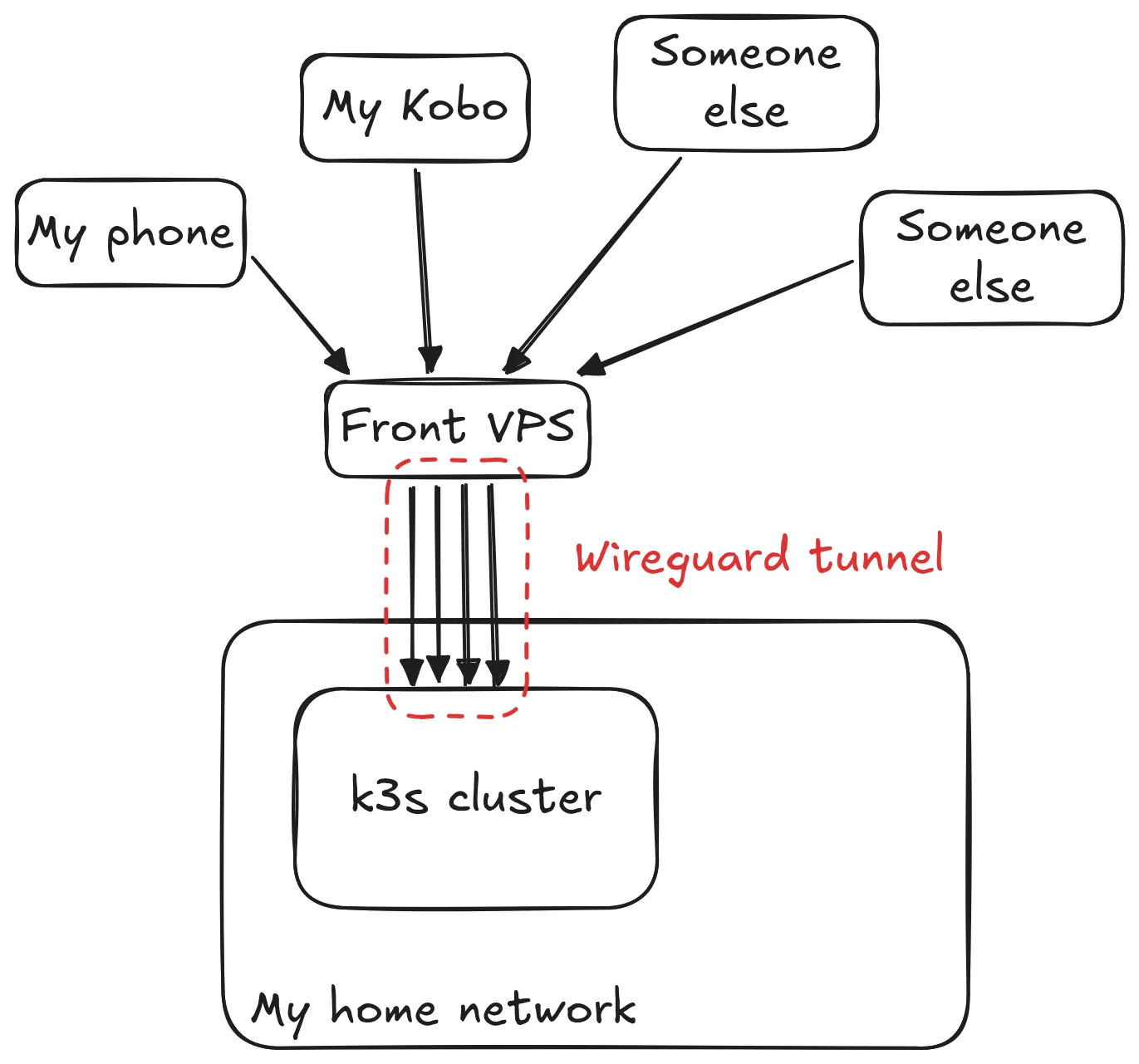
I rented a tiny VPS for €4/month at Infrawire (1 vCPU, 2 GB RAM, 25 GB NVMe). I installed a Debian 13 on it, because I want that front server to be as stable and low maintenance as possible, and installed the Debian-packaged HAProxy onto it. I also installed Wireguard. The VPS has a publicly accessible IP, so it will be my Wireguard server: my server at home can reach the VPS to establish a tunnel, the opposite is not true.
On my k3s node, I’ve installed Wireguard as well. I configured Wireguard on the VPS and my k3s node to establish a tunnel between the two. I’ve also bound the sshd on my VPS to the wireguard address. Infrawire offers a console so I can unstick myself if I locked me out of my own server (e.g. by misconfiguring Wireguard on any side, or if my server at home had any failure).
I pointed all my DNS records to the VPS. The HAProxy is a “dumb” tcp forwarder, so I can keep operating like before on my cluster. In particular, HAProxy doesn’t do TLS termination. My certificates are fetched on my cluster by cert-manager like before, using the http-01 challenge and Let’s Encrypt. I could also move to dns-01 challenges, but http-01 just works and lets me switch to a registrar without an API if need be.
That way, I don’t need a fixed IP at home, and I don’t have to do any port-forwarding from my home router to my k3s cluster. Even better: the VPS has an anti-DDoS protection included, and I can also configure HAProxy to refuse too many connections from a same IP, I can make it close TCP connections that take too long to establish, and more. If my VPS gets hammered, I can still access my services from within my home network.





 Comments